When I first started learning about worms, I had so many questions. One of the biggest was this: how do earthworms reproduce? They do not look like most animals. They do not have males and females the way mammals do. So how does it work?
In this guide, I will explain earthworm reproduction step-by-step in simple words. I will also explain do earthworms lay eggs, how long do worms live, what do worms eat, and where do earthworms live. I will use trusted research from universities and government agencies so the information is accurate and reliable.
Let’s start at the beginning.
Where Do Earthworms Live?
Before we talk about reproduction, we need to understand where do earthworms live.
Earthworms live in soil. They prefer soil that is:
- Moist
- Rich in organic matter
- Loose and well-aerated
According to the United States Department of Agriculture, earthworms are essential soil organisms. They improve soil structure, help water move through soil, and break down organic matter.
Different types of earthworms live in different layers:
- Surface dwellers live in leaf litter.
- Topsoil worms live just below the surface.
- Deep burrowers create vertical tunnels.
Healthy soil usually means healthy worm populations.
What Do Worms Eat?
To understand reproduction, we must also know what do worms eat.
Earthworms eat:
- Decaying leaves
- Plant matter
- Microorganisms
- Organic material in soil
They do not have teeth. Instead, they pull organic matter into their mouths and grind it in a muscular organ called a gizzard.
Research from Cornell Waste Management Institute explains that worms depend on microbes to help break down food. Worms digest both organic matter and the microorganisms living on it.
Good nutrition supports growth and reproduction.
How Do Earthworms Reproduce?
Now let’s answer the main question: how do earthworms reproduce?
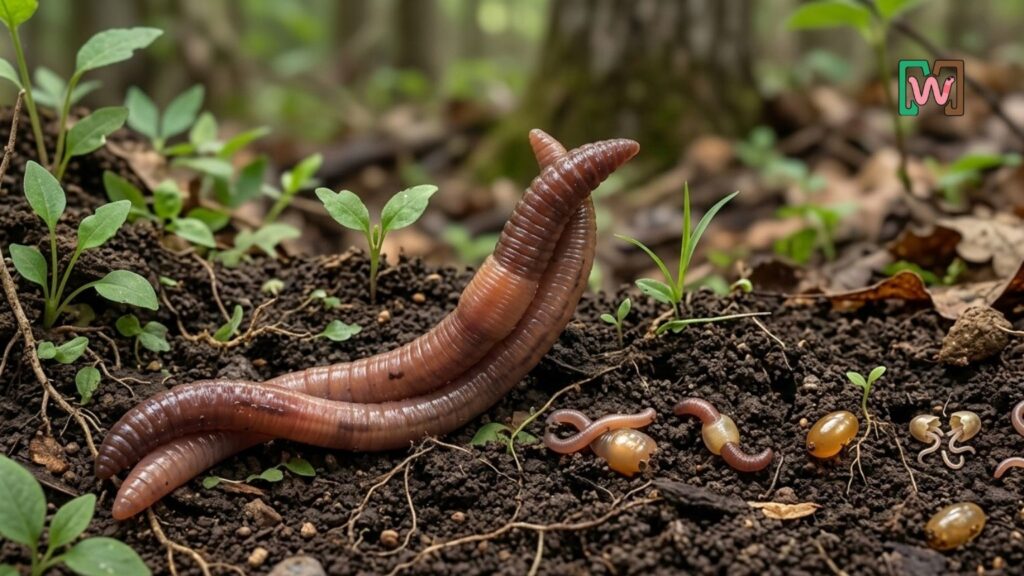
Earthworms are hermaphrodites. This means each worm has both male and female reproductive organs.
That does not mean they reproduce alone.
Most earthworms still need a partner to reproduce.
Step 1: Mating
When two mature worms meet, they line up in opposite directions. Their bodies touch at a swollen band called the clitellum.
The clitellum is the thick, lighter-colored band you see on adult worms.
During mating:
- Each worm exchanges sperm with the other.
- The sperm is stored inside special sacs.
This process can last several hours.
It usually happens at night when the soil is moist.
Step 2: Cocoon Formation
Many people ask, do earthworms lay eggs?
Yes, earthworms lay eggs, and not in the way you might expect.
After mating:
- The clitellum produces a slimy ring.
- The worm backs out of this ring.
- Eggs and stored sperm are deposited into the ring.
- The ring slides off the worm’s body.
The ring seals itself and becomes a cocoon.
The cocoon is small and lemon-shaped.
Each cocoon may contain:
- 1 to 5 baby worms, depending on the species.
This cocoon protects the developing embryos.
Step 3: Hatching
Inside the cocoon:
- Fertilization occurs.
- Embryos develop.
- Young worms grow.
Depending on temperature and species, cocoons hatch in:
- 2 to 4 weeks for compost worms.
- Several weeks longer for some soil species.
Moisture and temperature affect hatching speed.
Step 4: Growth to Maturity
Baby worms look like tiny, thin versions of adults.
They grow by:
- Eating organic matter.
- Expanding their body segments.
Most earthworms reach reproductive maturity in:
- 6 to 10 weeks for compost worms.
- Several months for larger soil worms.
When the clitellum becomes visible, the worm is mature.
Must Read : What to Feed Earthworms Guide
How Long Do Worms Live?
Another common question is how long do worms live?
The answer depends on species and environment.
According to agricultural research:
- Compost worms may live 1 to 5 years.
- Some larger earthworms may live up to 6 to 8 years under ideal conditions.
In nature, predators and weather shorten lifespan.
In controlled systems, worms may live longer.
Healthy soil, steady moisture, and good food increase survival.
Environmental Factors That Affect Reproduction
Earthworm reproduction depends on conditions.
Important factors include:
1. Moisture
Worms breathe through their skin. Their skin must stay moist.
Dry soil reduces reproduction.
2. Temperature
Most earthworms reproduce best between:
- 55°F and 77°F
Extreme heat or cold slows reproduction.
3. Food Availability
More organic matter means more reproduction.
Worm populations grow when food is abundant.
4. Soil Quality
Loose soil allows movement and cocoon placement.
Compacted soil limits growth and reproduction.
Are Earthworms Asexual?
Some worm species can reproduce without mating, but most common earthworms used in gardens and composting reproduce sexually.
Sexual reproduction increases genetic diversity, which helps worms adapt to changing environments.
Earthworm Population Growth
Under ideal conditions:
- Worm populations can double every 60 to 90 days.
- Growth slows when food or space becomes limited.
Population growth is controlled by:
- Food supply
- Space
- Moisture
- Temperature
Nature keeps balance through these limits.
Why Earthworm Reproduction Matters
Earthworm reproduction is important because worms:
- Improve soil structure
- Increase nutrient cycling
- Support plant growth
The United States Environmental Protection Agency explains that composting and soil health practices help reduce waste and improve environmental quality.
More worms mean healthier soil systems.
Do Earthworms Lay Eggs Above Ground?
Most earthworms lay cocoons in soil or organic matter.
They prefer:
- Moist soil
- Leaf litter
- Compost piles
Cocoons are usually buried for protection.
What Happens in Winter?
In cold climates:
- Earthworms burrow deeper.
- Reproduction slows or stops.
- Cocoons may survive freezing temperatures.
When soil warms again, activity increases.
Do All Earthworms Reproduce the Same Way?
The general process is similar across species.
Differences may include:
- Cocoon size
- Number of young per cocoon
- Time to maturity
- Lifespan
Compost worms reproduce faster than many deep-burrowing species.
Why Worms Do Not Overpopulate
People often worry worms will overrun soil.
They will not.
Worm numbers are limited by:
- Food supply
- Space
- Natural predators
Balance keeps populations stable.
Final Thoughts
So, how do earthworms reproduce?
They mate with partners. They exchange sperm. They form cocoons. Babies hatch. They grow and repeat the cycle.
It is simple. It is efficient. And it keeps soil alive.
When I look at healthy soil, I know there is a hidden system working below the surface. Worm reproduction keeps that system strong.
Healthy worms mean healthy soil.
Red Wiggler Composting Worms For Sale - Pure
Transform your food scraps and yard waste into rich, organic compost with Red Wiggler Composting Worms – Eisenia Andrei for Vermicomposting, Soil Health, and Organic Gardening. ALSO KNOWN AS CALIFORNIA RED Composting WORMS. These hardworking worms are nature’s composters, ideal for converting organic matter into nutrient-dense worm castings (also known as black gold). Perfect for home composters, gardeners, educators, and eco-conscious households.
Pure European Nightcrawlers For Sale - Eisenia Hortensis – For Composting
European Nightcrawlers (Eisenia hortensis) are larger composting worms ideal for processing organic waste in home or commercial composting systems. These active and resilient organisms adapt well to diverse composting environments, helping to create nutrient-rich soil amendment efficiently.
Frequently Asked Questions
How do earthworms reproduce?
Earthworms reproduce by mating with a partner, exchanging sperm, and forming cocoons that hatch into baby worms.
Do earthworms lay eggs?
Yes. They lay eggs inside protective cocoons produced by the clitellum.
How long do worms live?
Compost worms live 1 to 5 years. Some soil worms can live longer under ideal conditions.
What do worms eat?
Worms eat decaying organic matter and microorganisms in soil.
Where do earthworms live?
Earthworms live in moist soil rich in organic matter, from surface layers to deep burrows.

Samantha Flowers
Hi, I’m Samantha aka Meme, founder of Meme’s Worms, a commercial worm farm based in Valdosta, Georgia. I’m a hands-on worm farmer, educator, and business owner who has spent years raising, harvesting, and shipping Red Wigglers, European Nightcrawlers, and composting worms to gardeners, homesteaders, educators, and commercial growers across the United States. Everything I teach and write about here is based on real-world experience, not theory. View More