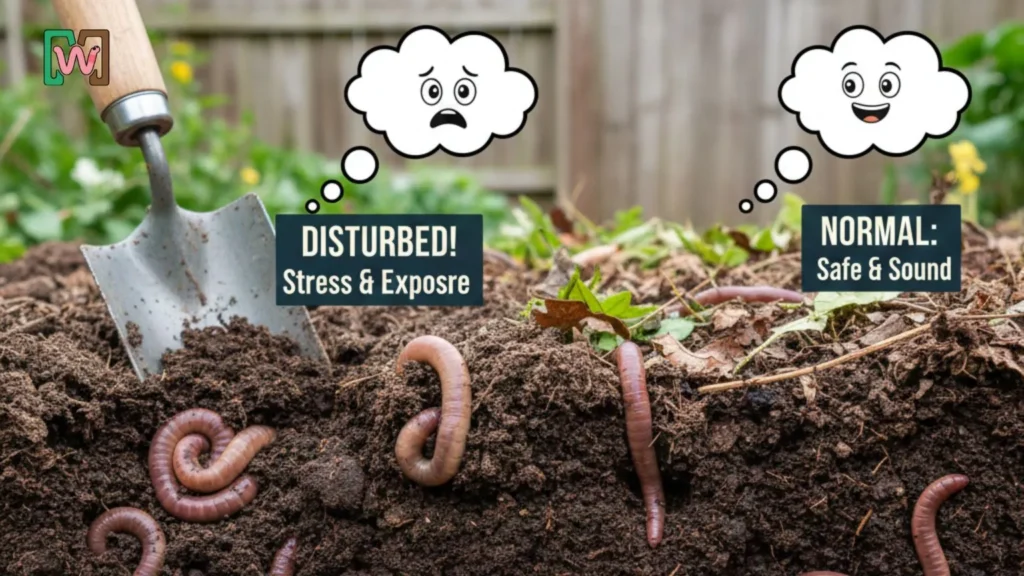
If you keep a worm bin, you have probably noticed that worms disappear the moment you open the lid, dig through bedding, or move the bin. This leads many people to wonder why worms hide so consistently, whether worms feel vibration, and how much disturbance is too much.
Worms are not fragile, and they are not misbehaving. They are responding to signals that tell them their environment may no longer be safe.
Understanding why worms hate being disturbed helps you tell the difference between normal behavior and stress behavior. It also helps you avoid common mistakes that slow feeding, reduce reproduction, and create long-term bin problems.
This guide explains why worms hide, how worms sense vibration and movement, what disturbed behavior looks like, and how to work in a bin without causing unnecessary stress.
Why Worms Hide When Disturbed
Why worms hide comes down to survival instincts.
In nature, composting worms live beneath layers of organic matter. They rely on darkness, moisture, and stillness to stay protected from predators and drying conditions.
When bedding is disturbed, those protective layers are temporarily removed. To a worm, this feels like exposure.
Hiding is not a sign of fear or weakness. It is a normal, healthy response that helps worms conserve moisture and avoid danger.
Worms that do not hide when disturbed are often stressed, unhealthy, or in an environment that no longer feels safe.
Do Worms Feel Vibration
Yes, worms feel vibration very strongly.
Worms do not hear sound the way humans do. Instead, they sense vibration through their skin and nervous system.
In nature, vibration often signals danger. Heavy footsteps, digging animals, rain impact, and collapsing material all create vibrations. Worms evolved to respond quickly by retreating deeper into their environment.
In a worm bin, vibrations come from:
- Lifting or setting down the bin
- Shaking or rotating containers
- Laundry machines or foot traffic nearby
- Frequent digging or stirring
Even mild vibration can trigger a retreat response.
How Worms Sense Disturbance
Worms sense disturbance through a combination of vibration, pressure changes, light exposure, and airflow.
When bedding is moved, multiple signals happen at once:
- Light enters deeper layers
- Airflow increases suddenly
- Moisture distribution shifts
- Vibration travels through the bin
Worms do not separate these signals. They experience them as one message: conditions are changing.
Their response is immediate movement away from the disturbance.
Must Read : How Worms Sense Moisture and Air
What Normal Disturbed Behavior Looks Like
Normal worms disturbed behavior is predictable and short-lived.
Normal responses include:
- Worms retreating deeper into bedding
- Worms spreading out again after the bin is closed
- Temporary clustering during maintenance
Once conditions return to normal, worms resume feeding and movement within hours.
This behavior means the bin is healthy.
Signs Disturbance Is Causing Stress
Disturbance becomes a problem when it is frequent or combined with other issues.
Signs of worm handling stress include:
- Worms remaining tightly clumped for long periods
- Worms crawling up walls after disturbance
- Reduced feeding over multiple days
- Strong odors developing after handling
These signs usually indicate that disturbance is stacking on top of moisture, airflow, or temperature problems.
Worm Handling Stress Explained
Worm handling stress happens when worms are exposed to repeated or prolonged disruption.
This includes:
- Over-harvesting worms
- Frequent full-bin stirring
- Constantly checking food zones
- Leaving bins open for long periods
Each disturbance forces worms to relocate and re-stabilize their environment. Over time, this drains energy and slows reproduction.
Worms thrive in stable systems. They do not need frequent intervention.
Must Read : Why Worms Live in the Dark (And Why Light Stresses Them)
Why Frequent Disturbance Slows Worm Activity
Worms expend energy every time they move to escape disturbance.
Energy used for relocation is energy not used for:
- Feeding
- Growth
- Cocoon production
This is why bins that are constantly handled often appear stagnant even when food and bedding seem correct.
Less disturbance almost always leads to better results.
How Much Disturbance Is Normal
Some disturbance is unavoidable and harmless.
Normal maintenance includes:
- Light surface feeding
- Adding bedding
- Occasional moisture checks
- Harvesting castings at long intervals
These actions should be quick and limited to small areas.
Daily digging or full-bin mixing is unnecessary for composting worms.
How to Reduce Disturbance in a Worm Bin
Reducing disturbance is simple once you understand worm behavior.
Best practices include:
- Feed in one area at a time
- Avoid mixing the entire bin
- Keep the bin covered when not working
- Place bins in low-traffic areas
- Allow several days between checks
Stability builds faster than constant adjustment.
Why Worms Sometimes Panic After Being Disturbed
If worms panic or attempt to escape after disturbance, something else is usually wrong.
Disturbance often exposes:
- Anaerobic pockets
- Excess moisture
- Heat buildup
- Poor airflow
The disturbance did not cause the problem. It revealed it.
This is why disturbed behavior should always be evaluated alongside smell, moisture, and temperature.
Why Hiding Is a Good Sign
Many beginners worry because they do not see worms.
Worms hide when:
- Bedding is comfortable
- Moisture is balanced
- Airflow is adequate
- Disturbance is minimal
A bin where worms stay hidden is usually a healthy bin.
Visible worms all the time often signal ongoing stress.
Must Read : Worm Behavior Basics: How Worms Sense Their Environment
When to Intervene and When to Leave Them Alone
Intervene when you see:
- Strong odors
- Persistent wall climbing
- Standing liquid
- Sudden die-offs
Leave the bin alone when:
- Worms retreat and resettle
- Feeding continues steadily
- No strong smells are present
Most bins improve faster with patience than with constant adjustment.
Final Thoughts on Why Worms Hate Being Disturbed
Worms hate being disturbed because disturbance signals danger.
They feel vibration, pressure, and environmental changes through their skin.
Hiding, retreating, and temporary clustering are normal behaviors.
Excessive handling creates stress, slows activity, and causes avoidable problems.
When you reduce disturbance and focus on stability, worms do the rest on their own.